

🎖️ General Abelardo L. RodríguezFrom Mexicali to the Presidency
A story of vision and progress: from the development of Baja California to national transformation (1889-1967)
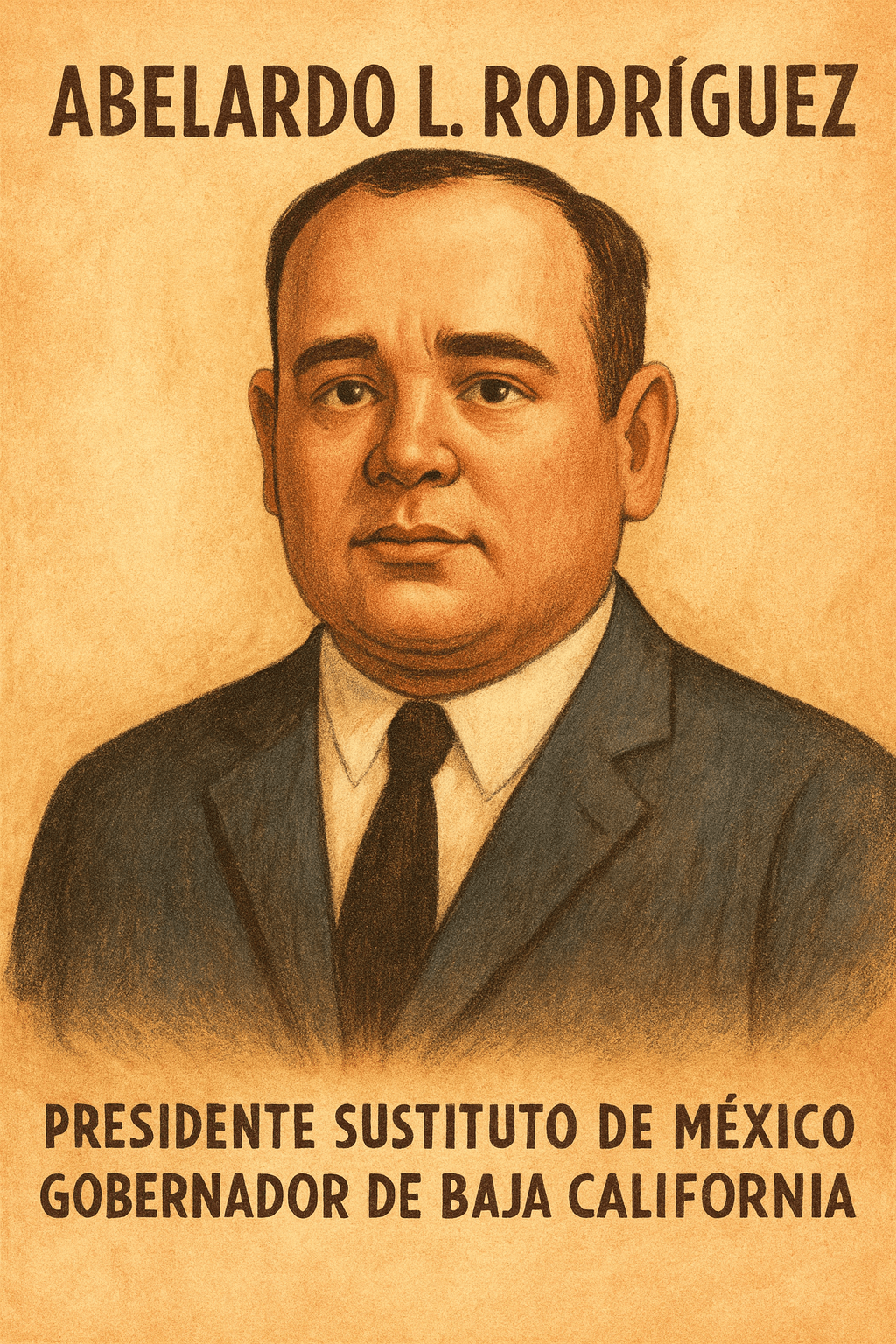
General Abelardo L. Rodríguez (1889-1967) - President of Mexico 1932-1934
"I led a serious, national government, devoted to fulfilling the principles of the Revolution"— On handing over the Presidency to Lázaro Cárdenas, 1934
Timeline: From Guaymas to Los Pinos
1889
Born in Guaymas
Sonora, May 12
1913
Joins the Revolution
Constitutionalist Army
1920
Subdues Cantú
Mission in Baja California
1923
Governor of BC
Great modernization
1927
Aircraft Factory
First in Mexico
1932
President of Mexico
Last non-elected one
1934
Minimum Wage
First national law
1967
Passes Away
La Jolla, California
An Extraordinary Story: From Humble Origins to the Presidency
🌟 An Unparalleled Career
In the history of Mexico, few figures have had a career as extraordinary as that of Abelardo L. Rodríguez. Born into a humble family in Guaymas, Sonora, with barely a primary education, this man rose to become the last President of Mexico not elected by popular vote and one of the great modernizers of Baja California.
🏆 A Legacy in Two Dimensions
His story is unique because he shone at both the regional and national levels:
- In Baja California: He transformed Mexicali from an isolated territory into a prosperous region
- In Mexico: He created institutions that endure to this day (NAFIN, Banobras, the minimum wage)
- A historic connection: The same man who modernized our region led the entire country
From Guaymas to the Revolution: The Origins of a Statesman
👤 A Sonoran of Humble Origins
Abelardo Luján Rodríguez was born on May 12, 1889 in Guaymas, Sonora,into a humble family. Unlike other leaders of his time who had a privileged education, Rodríguez barely completed primary school before seeking his fortune on the northern border.
🎓 The School of Life:
- • Formal education: Primary school only
- • The school of life: Working from a young age on the border
- • Practical learning: Trade, business, leadership
- • Entrepreneurial vision: Developed from his youth
- • Understanding of the people: He knew the needs of ordinary people
⚔️ The Revolutionary (1913-1920)
In 1913, Rodríguez joined Álvaro Obregón's Constitutionalist Armyto fight the regime of Victoriano Huerta. His bravery and leadership skills led him to take part with distinction in important military campaigns.
🎖️ Military Campaigns:
- • Capture of Culiacán: Distinguished participation
- • Pacification of the Yaqui: Campaign in Sonora
- • Plan of Agua Prieta (1920): Overthrow of Carranza
- • Promotion: Brigadier general for his merits
- • Baja California mission (1920): To subdue Cantú
Governor of Baja California: The Great Transformation (1923-1930)
🏛️ October 31, 1923 - Territorial Governor
On October 31, 1923, President Obregón appointed Abelardo L. Rodríguez as general governor of the Northern Territory of Baja California. From Mexicali, which served as the territorial capital, Rodríguez implemented a revolutionary government platform focused on economic reconstruction, social modernization, and the strategic use of the region's border advantages.
📊 The Challenge He Faced
Industrial Development
- First aircraft factory in Mexico (Mexicali, 1927)
- Developed commercial fishing industry
- Pioneering fish canneries
- Wine industry in the Santo Tomás Valley
- Economic diversification beyond cotton
Infrastructure
- Road network integrating the territory
- Rural roads for farming communities
- Irrigation canals for agricultural productivity
- Bridges for regional communication
- Modernized urban infrastructure
Education
- Massive school construction
- Training of specialized teachers
- Modern educational programs
- Technical education for regional development
- Universal access to education
Social Policy
- Promotion of organized labor unions
- Requiring companies to hire Mexicans
- Programs for national migrants
- Improvements in working conditions
- Integration of diverse communities
The Industrial Visionary: New Industries for Baja California
✈️ The Aircraft Factory: Mexicali at the Forefront
In 1927, Rodríguez created a local aeronautical company and established the first aircraft factory in Mexicali. This visionary decision placed our city at the national technological forefront, showing that he understood aviation would be strategic for connecting Mexico's vast distances.
🛩️ Achievements of the Aeronautical Company
🐟 Fishing Industry
He founded the country's first fish canneries. This industry would become one of the most important in the region.
🍇 Wine Industry
He developed olive cultivation and winemaking in the Santo Tomás Valley, the foundation of the renowned Baja California wine industry.
🏗️ Diversification
His goal was to make Baja California a prosperous and self-sufficient region, not dependent on a single crop.
President of Mexico: The Last Non-Elected One (1932-1934)
🏛️ The Road to Los Pinos
On September 4, 1932, after the resignation of President Pascual Ortiz Rubio,the Congress of the Union elected Abelardo L. Rodríguez as substitute constitutional President to complete the 1928-1934 term. He would become the last president not elected by popular vote in the history of Mexico.
🇲🇽 A Transformative Government
Despite coming to power without a direct popular election, Rodríguez led an active, reformist government aimed at confronting the Great Depression and continuing the post-revolutionary institution-building.
🏛️ Nacional Financiera (NAFIN)
Year: 1934
Description: Industrial development and promotion bank
Status: Active to this day
Impact: A pillar of Mexican industrial development
🏛️ Banobras
Year: 1933
Description: National Urban Mortgage and Public Works Bank
Status: Fundamental to this day
Impact: Financing of national infrastructure
🏛️ First Minimum Wage
Year: January 5, 1934
Description: First minimum wage in the history of Mexico
Status: Principle still in force
Impact: Permanent protection for workers
🏛️ Six-Year Presidential Term
Year: April 29, 1933
Description: Established a 6-year term for presidents
Status: System still in force
Impact: Foundation of the Mexican political system
🏛️ Petromex
Year: 1934
Description: First state-owned oil company
Status: Forerunner of PEMEX
Impact: Seed of the national oil industry
🏛️ Palacio de Bellas Artes
Year: 1934
Description: Completed construction of the supreme cultural venue
Status: Cultural heritage
Impact: Temple of the arts in Mexico
Mexico's First Minimum Wage
💰 January 5, 1934 - A Historic Milestone
In an unprecedented historic milestone, Rodríguez decreed the first minimum wage in Mexico, effective as of January 5, 1934, setting minimum pay rates by region. This revolutionary measure protected millions of Mexican workers and established a principle of social justice that endures to this day.
🏆 Transformative Impact
The Final Years: Entrepreneur and Return Home
💼 The Successful Entrepreneur
After leaving the presidency, Rodríguez devoted himself to business with the same vision that had characterized him as a ruler. He founded private banks and companies, becoming one of the wealthiest men in Mexico.
🏢 A Business Empire:
- • Banco de Crédito Mexicano
- • Banco Mexicano de Occidente
- • Astilleros Rodríguez
- • Pesquera del Pacífico
- • Food canneries
🏛️ Governor of Sonora (1943-1948)
Rodríguez returned to public service as governor of Sonora,his home state, although he resigned before completing the term due to health problems. His commitment to public service never ceased.
⚰️ The End (1967):
He died on February 13, 1967 in La Jolla, California, at the age of 77. His remains rest in Ensenada, Baja California.
An Eternal Legacy: Institutions That Endure
🌟 A Unique Figure in Mexican History
Abelardo L. Rodríguez is a unique figure because his legacy transcends regional and temporal boundaries. More than half a century after his death, his national institutions are still functioning and the industries he established in Baja California remain regional economic pillars.
💡 The Lesson of His Life
His life shows that humble origins are no obstacle to greatnesswhen combined with vision, hard work, and dedication to the common good. From a poor child in Sonora to President of Mexico, his journey inspires generations of Mexicans to fight for their dreams and to serve their country.
🇲🇽 A Permanent National Legacy
- • Six-year presidential term: The system in force since 1934
- • No immediate reelection: A fundamental democratic principle
- • Minimum wage: Basic labor protection
- • NAFIN: Industrial development bank
- • Banobras: Infrastructure financing
- • The seed of PEMEX: Through Petromex
- • Palacio de Bellas Artes: The supreme cultural venue
🌊 His Legacy in Baja California
- • Fishing industry: The first in the country
- • Wine industry: Recognized worldwide
- • Tijuana Airport: Officially bears his name
- • Economic diversification: Beyond cotton
- • Basic infrastructure: Roads and communications
- • Educational system: Schools across the territory
To Learn More
Historical Sources
- • General Archive of the Nation (Presidents Collection)
- • Historical Archive of the Municipality of Mexicali
- • National Institute of Historical Studies
- • Archive of the Presidency of the Republic
- • National Newspaper Library (newspapers 1932-1934)
Places to Visit
- • Tijuana Airport (bears his name)
- • Palacio de Bellas Artes (Mexico City)
- • Ensenada (family mausoleum)
- • Mexicali (sites of his government)
- • Regional Museum of Mexicali
His Living Legacy
- • Every minimum wage paid in Mexico
- • Every six-year presidential term
- • NAFIN and Banobras in operation
- • The fishing industry of BC
- • The Mexican wine industry
📞 Additional Information
Historical Archive
📞 Municipal Historical Archive:
(686) 558-1000
🏛️ Institute of Culture of BC:
(686) 552-8400
📧 Email:
historia@mexicali.gob.mx
Contribute to History
📝 If you have historical information:
- • Photographs from his presidential period
- • Documents from his companies
- • Testimonies about his government in BC
- • Objects from the era of his governments
- • Accounts of his development projects